R&A Electronics Market Watch | July 2026
AI Data Centers Shift Supply Pressure Beyond GPUs
Power delivery, optical interconnects, thermal management, enterprise storage, and high-end passive components are becoming new procurement risk areas.
Semiconductor Supply Chain Update | July 2026
Key Takeaway
AI infrastructure demand is entering a more system-level phase. The market is no longer only watching GPUs, HBM, and advanced logic. As AI data centers scale, procurement pressure is spreading into power delivery, optical interconnects, thermal management, enterprise storage, and high-specification passive components.
Recent market signals show that AI data center expansion is reshaping semiconductor demand beyond the most visible compute components. As server racks become denser, power consumption rises, data traffic increases, and thermal requirements become more demanding, the supporting components around compute and memory are becoming more critical to system availability.
For OEMs, ODMs, EMS providers, industrial manufacturers, and procurement teams, the risk is no longer limited to whether GPUs or HBM are available. The wider question is whether the full component set needed to build, power, connect, cool, and maintain AI systems can be secured on time.
In practical sourcing terms, the next pressure point may not come from one headline component. It may come from a supporting component that delays the full system.
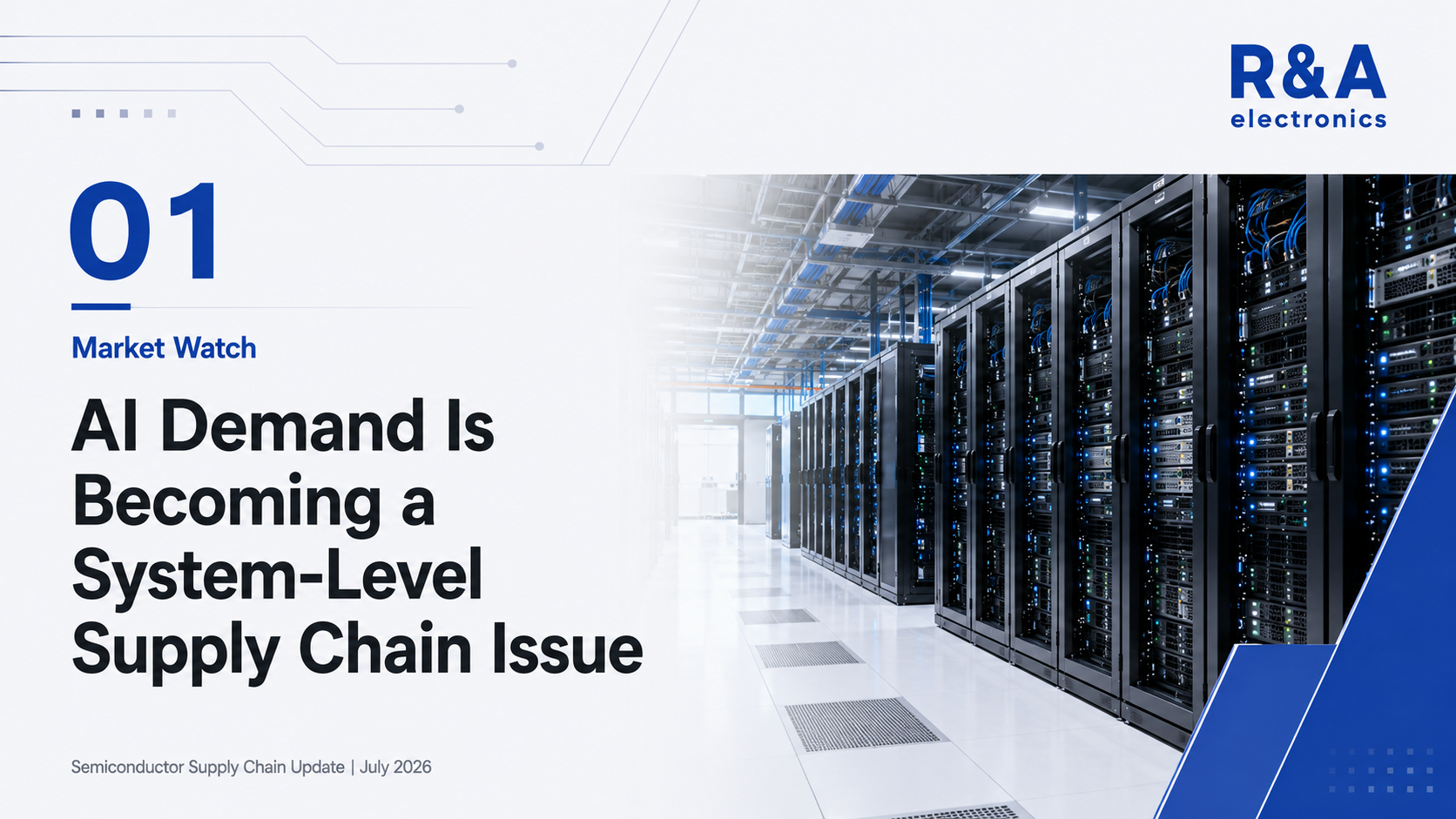
SIA and Deloitte estimate that semiconductors account for around 95% of an AI data server rack’s value, covering not only processors and memory, but also networking, power, storage, sensors, analog, and other supporting chip technologies. This reinforces a key supply-chain point: AI infrastructure demand is not concentrated in one device category. It is pulling on a much broader electronics ecosystem.
This matters because AI server deployment is becoming more power-intensive, data-intensive, and thermally demanding. As more AI infrastructure projects move from planning to deployment, procurement teams need to review risk across the full system, not only the most visible AI chips.
95%
Estimated semiconductor value share in an AI data server rack.
31%
AI-optimized servers are expected to account for a larger share of data center power consumption in 2026
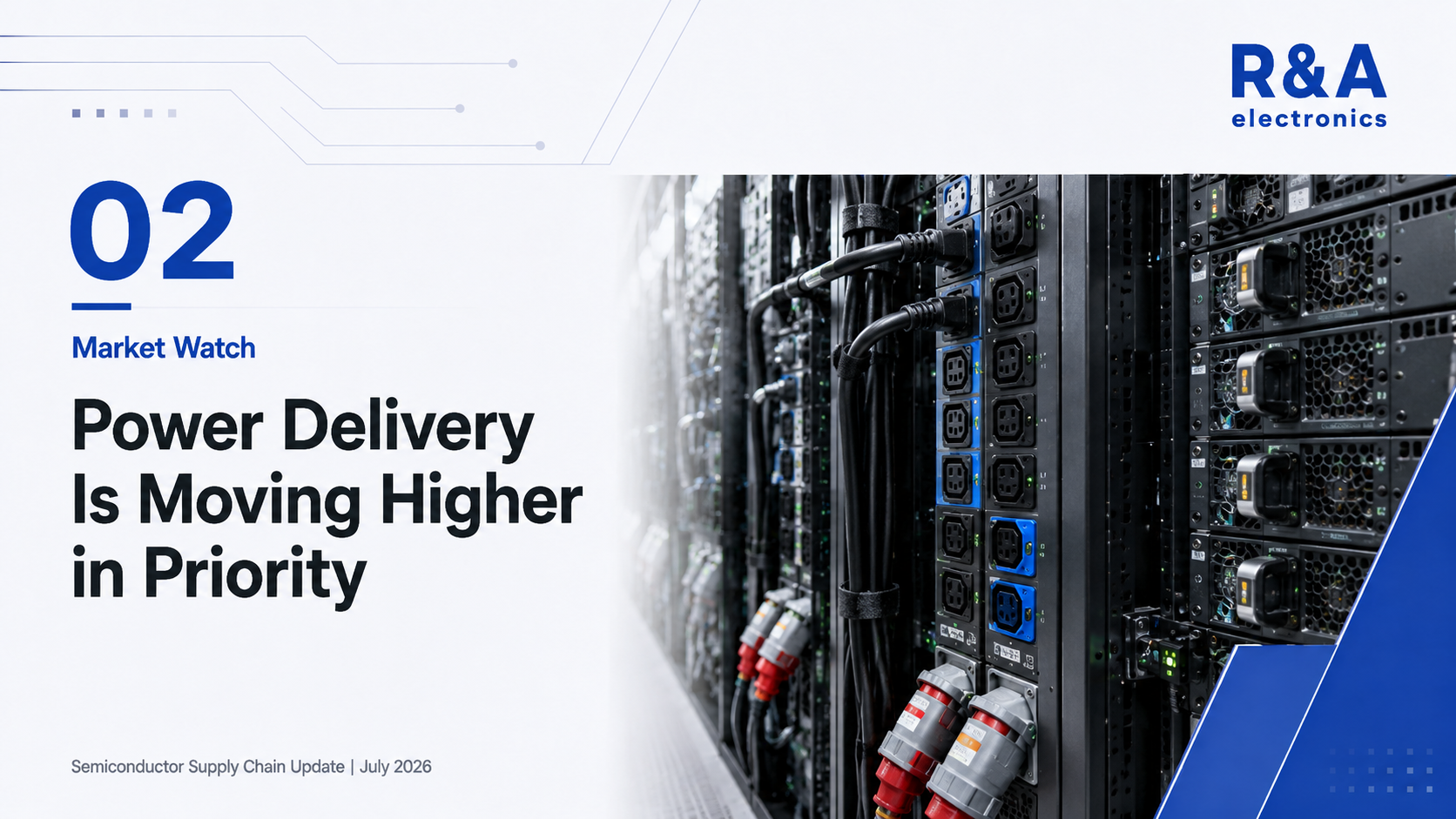
Power is one of the clearest pressure points. Gartner estimates that data center electricity consumption will grow 26% in 2026, while AI-optimized servers are expected to account for 31% of data center power consumption in the same year. By 2027, AI-optimized server power consumption is expected to surpass that of conventional servers.
This shift has direct implications for component sourcing. AI servers and AI infrastructure platforms require more advanced power management across processors, accelerators, memory, storage, networking modules, and rack-level infrastructure.
As a result, PMICs, MOSFETs, voltage regulators, power modules, current sensors, hot-swap controllers, eFuses, isolated and non-isolated converters, gate drivers, and related analog components need closer monitoring.
The important point is that many of these products depend on mature-node or specialty manufacturing capacity. They may not receive the same public attention as advanced logic chips, but they remain essential to system operation. A delayed power component can create the same production risk as a delayed processor.
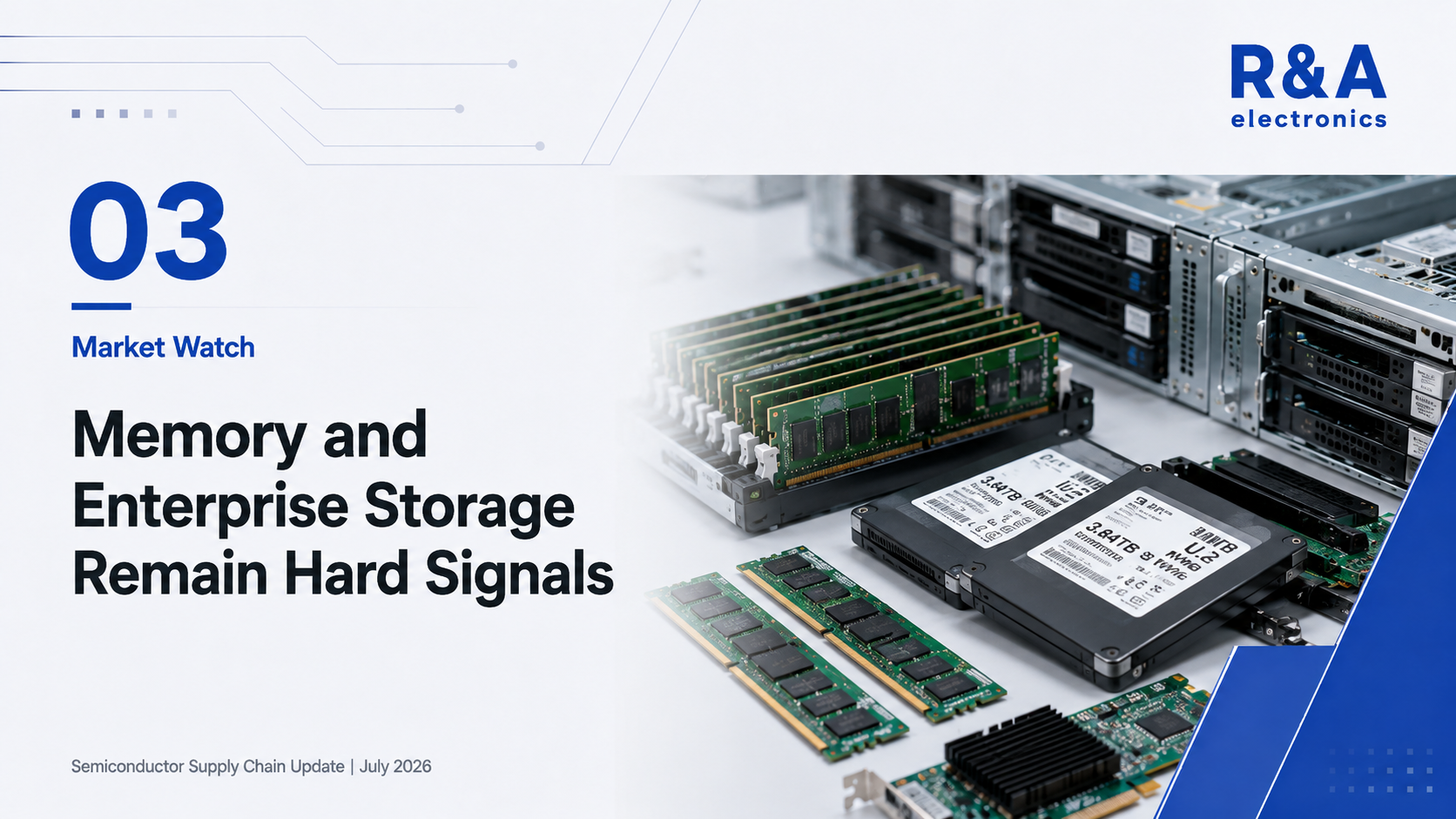
Memory remains one of the strongest indicators of AI-driven supply pressure. TrendForce expects Server DRAM contract prices to rise 13–18% quarter-on-quarter in 3Q26. This confirms that AI server demand continues to support pricing strength across key memory categories.
At the same time, enterprise storage is entering a new upgrade cycle. Samsung has announced mass production of its PM1763 PCIe 6.0 enterprise SSD, positioned for next-generation AI and HPC servers. The product highlights higher performance, power efficiency, advanced NAND, controller technology, and liquid-cooling optimization.
This shows that AI server infrastructure is not only about compute and HBM. Storage performance, controller availability, NAND supply, firmware compatibility, power efficiency, and thermal design are also becoming part of the procurement discussion.
For buyers, memory and storage should be reviewed together, especially for AI servers, data center platforms, networking systems, and high-reliability industrial applications.
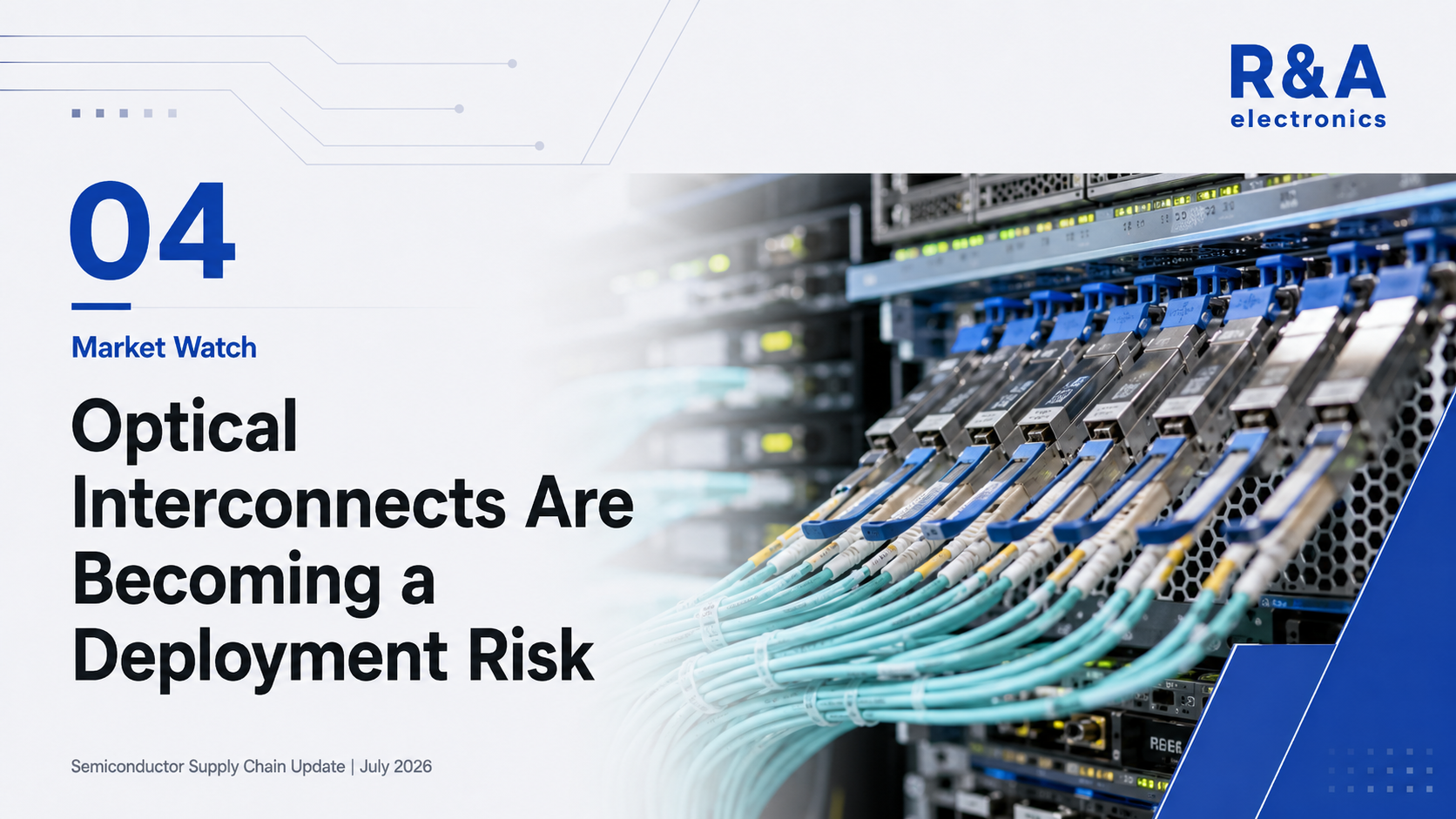
As AI clusters scale, data movement becomes a major system bottleneck. Large AI systems require high-speed interconnects between accelerators, switches, storage systems, and networking infrastructure.
This is increasing attention on 800G and higher-speed optical modules, optical engines, laser components, drivers, DSPs, retimers, and related networking ICs. TrendForce has noted that demand for 800G and above optical transceivers is rising sharply as AI server cluster interconnects expand, while upstream component availability and manufacturing bottlenecks can constrain capacity expansion.
For procurement teams, the key issue is not only module price. Qualification status, supplier allocation, upstream optical component availability, firmware compatibility, thermal performance, and system interoperability may all affect deployment schedules.
In many cases, alternative sourcing for optical and high-speed networking components cannot be completed quickly. This makes early visibility especially important for OEMs, ODMs, and network equipment manufacturers.
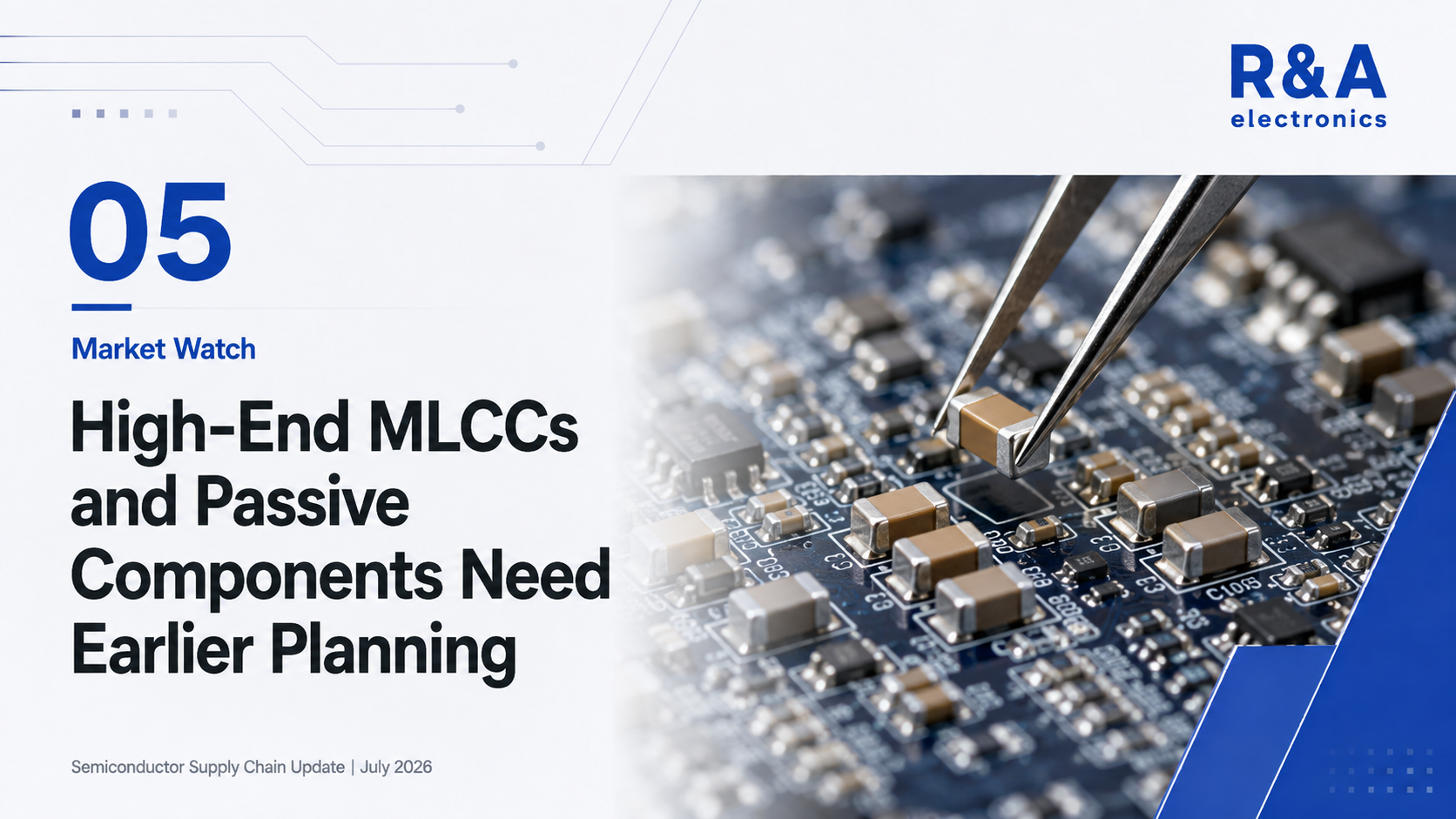
Passive components are also becoming more important. TrendForce has reported that AI server platform upgrades and AI-related orders are increasing demand for high-end MLCCs, with Japan and Korea suppliers’ book-to-bill ratios reaching post-pandemic highs and shortage risks rising in the second half of 2026.
This does not mean every passive component is in shortage. The more accurate risk is specification-level imbalance. Certain capacitance, voltage, size, temperature, reliability, and performance combinations may become tighter than standard products.
For AI servers, automotive electronics, industrial platforms, networking equipment, and high-reliability applications, passive components are not simply low-value background items. In high-density systems, MLCCs, capacitors, connectors, sensors, and board-level components can directly affect system stability and production continuity.
Procurement teams should therefore review passive components by specification, not only by category.
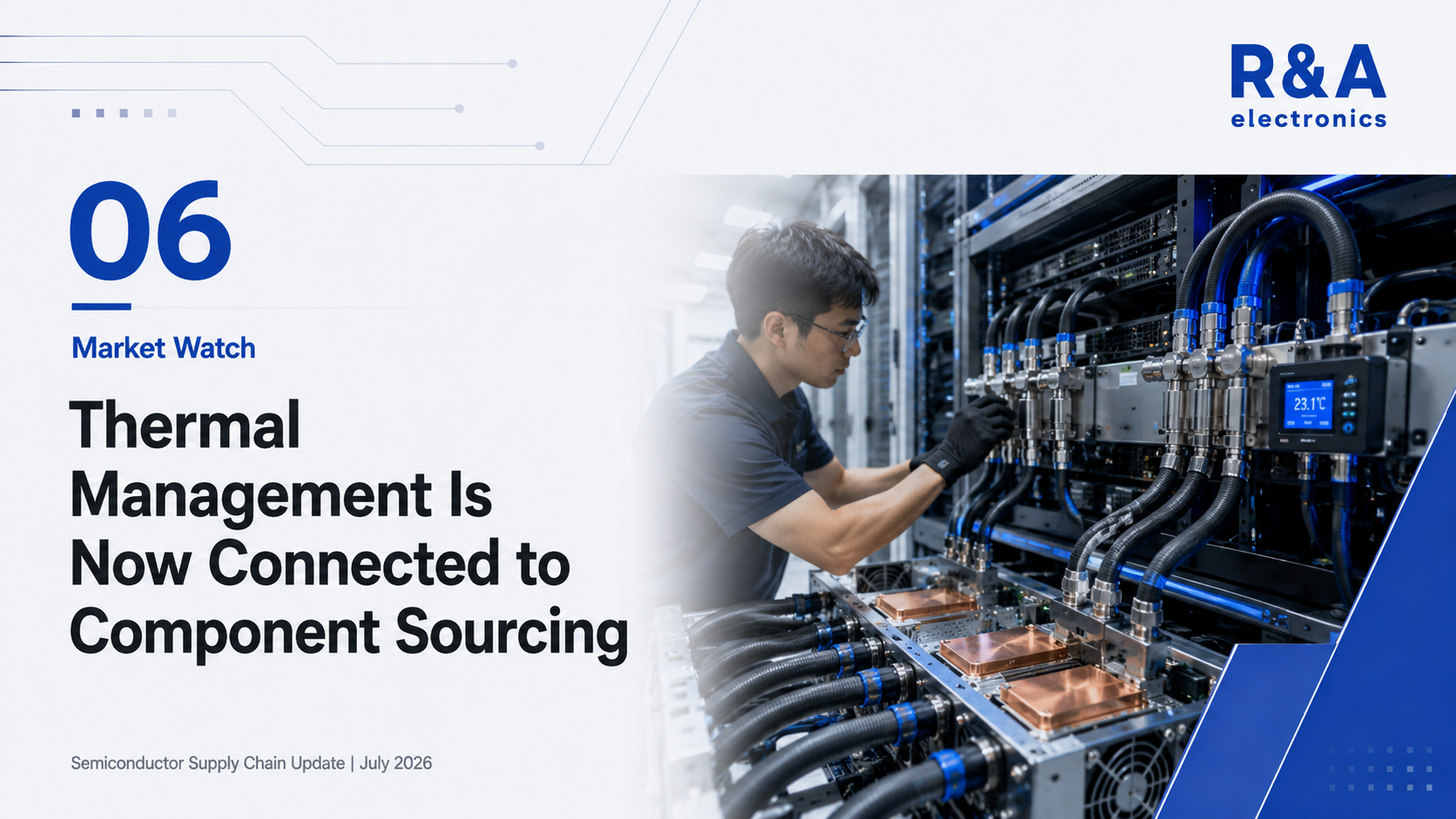
As AI server power density rises, thermal management becomes a sourcing issue as well as an engineering issue. Liquid cooling, higher rack density, and more demanding thermal designs increase the importance of sensors, controllers, connectors, pumps, fan control systems, monitoring ICs, and cooling-related electronic components.
Samsung’s PM1763 SSD announcement also highlights liquid-cooling optimization for demanding AI workloads, showing that thermal design is extending into storage and system-level architecture.
This reinforces a broader point: AI infrastructure is becoming more integrated. Compute, memory, storage, power, networking, and cooling are no longer separate sourcing discussions. They are increasingly linked within the same deployment schedule.
What This Means for Procurement Teams
Procurement teams should treat AI infrastructure as a system-level supply-chain issue. The focus should not only be on the most visible AI chips. Supporting components may create bottlenecks if demand accelerates faster than supplier capacity, qualification cycles, or forecast visibility.
Procurement teams should monitor:
- Lead-time changes by specification
- Supplier allocation behavior
- Forecast submission requirements
- Spot-market movement
- Approved alternative status
- Single-source exposure
- Long-lifecycle program risk
Categories to review:
- Power: PMICs, MOSFETs, gate drivers, voltage regulators, protection devices
- Memory and storage: Server DRAM, NAND, enterprise SSDs, controllers, eMMC/UFS where applicable
- Optical and networking: 800G+ modules, lasers, drivers, DSPs, retimers, optical engines
- Passive components: high-end MLCCs, high-capacitance capacitors, high-reliability passives
- Thermal systems: sensors, controllers, connectors, cooling-related electronic components
R&A View
AI infrastructure demand is shifting from component-level pressure to system-level pressure. GPUs and HBM remain important, but the supporting infrastructure around them is becoming more complex and more component-intensive.
Power delivery, optical interconnects, enterprise storage, thermal management, and high-specification passive components are now more closely tied to AI deployment schedules.
For procurement teams, the practical approach is to review BOM exposure beyond headline AI chips. Components that appear secondary on a BOM may still become critical if lead times extend, allocation tightens, or approved alternatives are not ready.
R&A Electronics will continue to monitor pricing, lead-time, and allocation signals across key semiconductor and electronic component categories to support more informed sourcing decisions.
Procurement teams should not only ask: "Which AI chips are tight?" They should also ask: "Which supporting components could delay the full system?"
Frequently Asked Questions
Is AI demand still mainly a GPU and HBM issue?
No. GPUs and HBM remain central, but AI infrastructure demand is increasingly affecting power delivery, optical interconnects, storage, thermal management, and high-specification passive components.
Which component groups should procurement teams monitor first?
PMICs, MOSFETs, voltage regulators, analog ICs, Server DRAM, enterprise SSDs, 800G+ optical modules, high-end MLCCs, sensors, connectors, and cooling-related electronic parts deserve closer review.
Does this mean all power and passive components are in shortage?
Not necessarily. The risk is more likely to appear by specification, supplier, qualification status, and application area. High-reliability and high-performance specifications require closer tracking.
Why are optical components becoming more important?
AI clusters require high-speed data movement between accelerators, switches, storage systems, and networking infrastructure. As bandwidth requirements rise, optical modules and upstream optical components become more important to deployment schedules.
What should buyers do now?
Review BOM exposure, confirm lead times, identify single-source risks, validate approved alternatives, and prioritize long-lifecycle programs that rely on high-reliability power, optical, storage, thermal, or passive components.
Need support with semiconductor sourcing?
R&A Electronics helps procurement teams monitor market movement, review sourcing options, and respond faster to changing semiconductor supply conditions.
Contact R&A